THE SUHNDI RELIGION:
WORSHIP OF THE ONE DEITY, SALAMAN
The Suhndi are a Monotheistic human civilization worshipping Salaman.
In this Section, You Will Find:
The Deity, Salaman
Tenets of the Worship of Salaman
The Three Branches of the Suhndi Religion
Salaman's Holy Symbol
THE DEITY, SALAMAN
Salaman is a Lawful Good deity who denies the existence of other deities.
His followers feel that worshippers of other deities are at best misguided,
and are in many cases a corrupting influence to be stopped or converted.
Worshippers of Salaman take their own purity seriously, and fear their god
mightily; after all, Salaman sank their entire home continent beneath the ocean,
for it had become a land without sufficient righteousness.
But as water is the engine of Salaman's wrath, so too it is the symbol of a
worshipper's humility before him. In Sundhi temples, on Sundhi doorsteps, and
along Sundhi roads, bowls or saucers of water are often left by passersby as
symbols of blessing or penitence.
Salaman's Domains are Water, Magic, Knowledge, Law, and Good. His favored weapon
is a curved blade: scimitar, falchion, or kukri.
TENETS OF THE WORSHIP OF SALAMAN
Worship of Salaman means striving for purity and order. Worshippers fast one day
per week, taking in only water, and spend one day per month dry, taking in no water.
One week per year they live under a vow of silence, and most choose to live one year
of their life in silence too. These deprivations mean to keep worshippers humble,
reflective, and ever vigilant against any glimmer of corruption in their souls.
No beer or whiskey is allowed, though oddly beverages fermented from fruit are okay,
so wine and cider are permitted, in moderation. Dancing is an orderly, elegant,
very formalized aspect of romantic courting. Sex is permitted after a couple swears
before a priest that they will marry--and breaking such a promise is catastrophic.
Upon waking each day, every worshipper prays to recognize the opportunity of the new
day. This takes only one minute, but the most pious take that minute even if they've
been roused by screams of "fire!"
Every worshipper must pray once daily for a pure heart. In a foreign land, they are
supposed to pray publicly, as an inspiration to potential converts. The prayer,
however, need not be elaborate; two minutes of chanting on a street corner while
holding the holy symbol will do. Once per week, followers are also required to pray
for the purity of a neighbor. When they do so, they leave that neighbor an
anonymous blessing of water. (This is not Holy Water unless actually blessed by a
priest--it is merely symbolic.)
The main creed of the religion is "One king alone rules the world and one king
alone serves him." Of course the first "king" is the deity Salaman; the king who
serves him is the anointed Caliph in Hephiontias (the capital of Zymyria).
The Caliph is not only the head of the Zymyrian government, he (or she) is also
the head of the entire religion. The Suhndi see no distinction between the two:
the state is the faith and vice-versa. The Caliph (currently Aledd Watid, a priest
who earned his reputation in vanquishing several Niterran Monasteries about 15 years
ago) is considered Infallible and is deferred to on all matters in Zymyria.
While the Caliph claims supremacy in all matters through all Suhndi lands,
the geopolitical facts differ slightly. The other Suhndi states (Numyria,
Shialaria, Niterra, Syabassar, Padashah, Saraca, and Zalazar, as well as the "Wild
States" Memrah'Assar, Uqbar, and Zu) lie just far enough from Hephiontias that their
leaders (the Zyiph) are able to exercise some subtle independence. These rulers are
members of the same clericy, but they are aware that their populations are not as
fundamentalist as the Zymyrians. Mob hysteria (the sort that leads to burning Sorcerer
children or cutting off the ears of half-elves) sweeps these regions less often--
but sometimes their rulers are obligated to "invite" the Zymyrian army to sweep
through on a "purge" of "corrupting influences" among the populace. The authority
of the theocracy should not be tested.
Obedience to the law is of paramount importance to the Suhndi. Primarily a Lawful
Good religion, its demand for an orderly world is both its greatest strength
(encouraging deep, structured inquiry into nature and mysticism) and its most
destructive problem (all too often retreating to rigidly traditional dogma).
THE THREE BRANCHES OF THE SUHNDI RELIGION: CONTROVERSY!
MAINSTREAM SUHNDI is Lawful Good and is headquartered in Hephiontias, Zymyria.
It sincerely recognizes the Caliph as the lone infallible mortal in the world and
seeks to purge the world of corrupting impurities. Mainstream Suhndi can be
civil and even warmly hospitable to outsiders, but rarely do the Suhndi fully trust
them; every mainstream Suhndi city has an area called the Sacradhi, where
nonbelievers are forbidden to enter. At times, the mainstream Suhndi have become
violent crusaders in their attempt to convert (or wipe out) nonbelievers, but more
common is just a low-burning suspicion of the rest of the world. Zymyria, the
largest and most populous of the Suhndi states--and the only one where mainstream
faith has no real competition--shows a tendency to view other independent Suhndi
countries as merely their outlying "principalities" or "protectorates."
KAHWAN SUHNDI is Lawful Neutral and finds adherents among the northern
states of Shialaria and Niterra. It accepts the Caliph as infallible, but posits
that he is not the only infallible mortal. Instead, through intensive study and prayer
any person may achieve that divinely anointed status. Individuals who do so are
named Saints and are believed even after death to linger as spiritual guides and
protectors. Monasteries are dedicated to them. Predictably this is blasphemy in
the eyes of the Caliph, and periodically the monasteries are raided and burned to the
ground. If captured during the raid, usually the monks and Kahwan worshippers face a
stark choice: recant or die. So the Kahwan Suhndi try to keep a low profile.
HALIDAN SUHNDI is Neutral Good and finds adherents in the states Padashah,
Saraca, and Zalazar. Though not publicly, Numyria is in fact a Halidan state too,
and its Zyiph, though of course a professed Mainstreamer obedient to the Caliph, is
thought among his own population to be a sincere Halidan in his theology. Halidan
theology posits that Salaman values "good acts" over the specifics of law and order. This
interpretation allows that sometimes a greater good is achieved by violating a law.
Which, of course, is blasphemy in Zymyrian eyes. So the Halidan also lay low.
Perhaps the differences between the three branches are best illustrated in action:
A man steals a loaf of bread to feed his starving family...
MAINSTREAM REPLY: Condemn the man for breaking the law! Better to starve in piety
than to feed in impurity! During times of hysteria--which sweep the faith periodically--
the man may even be condemned violently for his minor crime, and a particularly stern
mainstreamer will extend the condemnation to the family that unknowingly ate the bread.
Salaman forgive us!
KAHWAN SUHNDI: The thieving man has erred, but by supplicating himself before
a Saint, he can come to understand why and redeem his life. Redemption after all
is a matter of inner order; when a worldly law is broken, this is worrisome not
for its impact on the world, but because it suggests a broken spirit. The Saints, who
once were flawed and now are perfect, can guide such a man to calm righteousness.
Salaman, lead us to your perfection.
HALIDAN SUHNDI: There is nothing to forgive! The man violated one law, but he
achieved a greater good than if he had obeyed it--he saved Suhndi lives, Salaman
be praised!
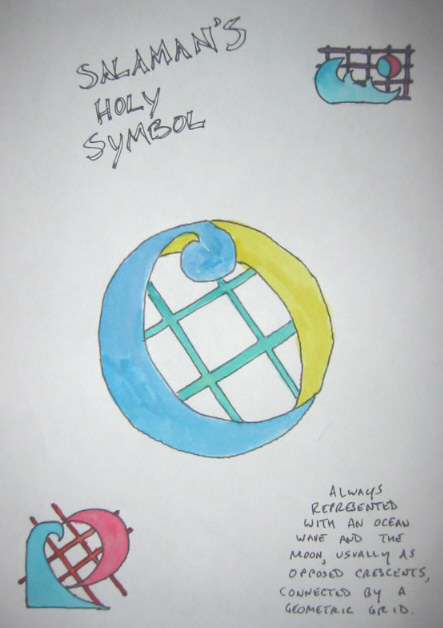
SALAMAN'S HOLY SYMBOL
The only art conceived by the Suhndi is religious in theme; therefore despite their
strictness, they are remarkably free with how they render their holy symbol. It is
considered an appropriate subject for artists to interpret in various ways, as long
as it contains the following elements:
1. A wave of water representing Salaman's righteous wrath
2. The moon representing his ever-present though often-hidden eye
3. A geometric grid connecting the two, illustrating Salaman's pervasive, connecting order
Usually the water and moon are presented as opposing crescents, implying a perfect cirle.
Predictably, the symbols of Zymyrian and Numyrian priests are the most staid;
those carried by priests from Niterra and Saraca can be startlingly abstract.
Back to the main Landen page.